Spread spectrum techniques
Introduction
In this article, we will discuss spread spectrum technology and the various schemes that are used.
Spread spectrum is an extra stage in the modulation process producing a final signal occupying a bandwidth many times that of the initial signal. Although this may seem counter intuitive, there are benefits over conventional methods.
The most familiar spread spectrum techniques are Frequency Hopping Spread Spectrum (FHSS) and Direct Sequence Spread Spectrum (DSSS).
Communication using channels
In radio communication, the user transmits a signal, for example on 434.075 MHz. To receive the signal, we must tune our receiver to the same frequency.
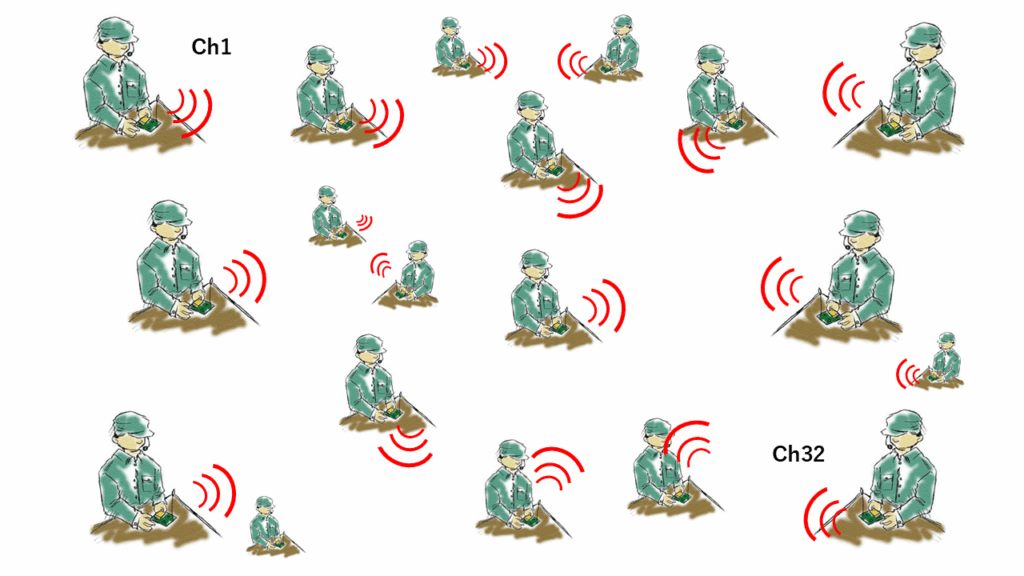
Users communicating on different channels
If users just transmitted on any frequency, communication will be impossible due to interference. Therefore we create slots or channels to create a channel plan. Thus a radio module may be equipped with for example, 32 selectable channels.
Disadvantages of using channels
Avoiding interference using frequency channels is known as Frequency Division Multiplexing (FDM) and it is one way of having multiple channels in a frequency band. As long there is no overlap between the signals, they will not interfere with one another.
However this setup is not perfect.
Multiple radios in the same area
Let us imagine that there are 2 systems (TX1-RX1 and TX2-RX2).
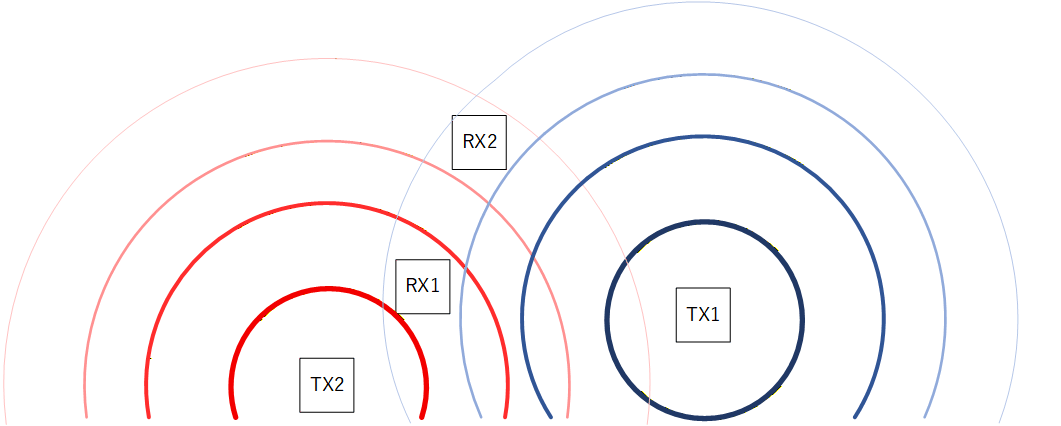
Multiple radios: the link between TX1 and RX1 is weakened due to the impact from transmitter TX2.
If there are multiple radios in one area, problems occur when using channels. Receivers are not completely ideal and the likelihood of interference increases if more channels are used in tighter spaces. In the diagram, RX1 is within communication range of TX1 and communication occurs normally. However, another transmitter (TX2) is closer to RX1 and begins communicating on the same channel or an adjacent channel. The communication between TX1 and RX1 will be permanently impaired.
Relying on a channel system requires agreements among users on who or which channels are to be used.
Signal interception and security
Radios transmitting on fixed frequency channels means anyone with a receiver capable of tuning into that frequency can receive and demodulate that signal. There are potential situations that may arise.
For instance, a receiver can capture or record the entire signal. Being able to play back the signal can leave a communication link open to attack. Going further, knowledge of the system's communication protocol allows anyone, other than the intended recipients, to access sensitive information.
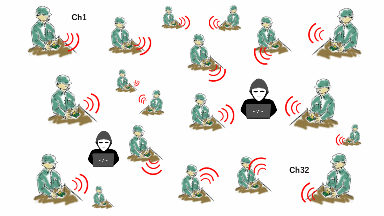
Anyone with a receiver covering the appropriate frequencies can receive and decipher the signal.
Environment
Multipath propagation are waves taking various routes to the receiver causing constructive and destructive interference.
Two path model
Take the simplified example with 2 waves (one direct and one reflected). Both arrive at the receiver in phase (0°) in which their wavelengths add to produce a larger wave or both are out of phase (180°) and the wavelengths cancel to produce a null. Because wavelength is a factor, the effect will vary across all frequency channels.
For more information on the two wave model, see "2-path model" in Propagation article.
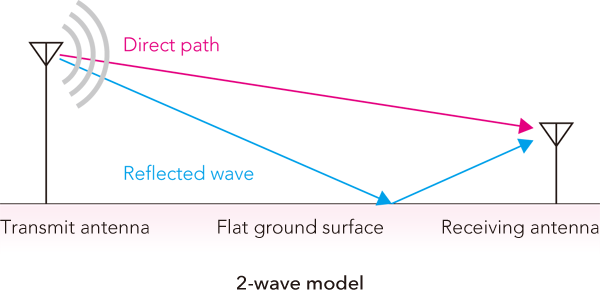
Two path model
Interference from other wireless equipment
Other wireless equipment using similar frequencies are a problem. If protocols for using the frequency band do not exist (for example checking if the channel is clear before transmitting), users have to tolerate any interference emitted by other equipment. To prevent any interference, it is important that all user systems follow the same protocol.
So how does spread spectrum help overcome these problems?
What is spread spectrum?
When we band limit all the transmitted signals in a channelised system, this naturally places an upper limit on the frequency deviation and therefore data rate.
With spread spectrum on the other hand, we do not constrain the bandwidth in the same manner and resultant transmitted signal has larger bandwidth than the minimum required.
Frequency Hopping Spread Spectrum
In Frequency Hopping Spread Spectrum (FHSS), the transmitter is constantly changing the carrier frequency and the signal "hops" from one frequency to another. Although the bandwidth is unchanged at each hop, the hopping action spans a wide range of frequencies so that overall, the signal is wide banded.
Hopping pattern
The hopping pattern describes the way the transmitter and receiver move from one frequency to another. One method is to use a seed to determine the subsequent frequency hop. This seed is known only to the corresponding transmitter and receiver.
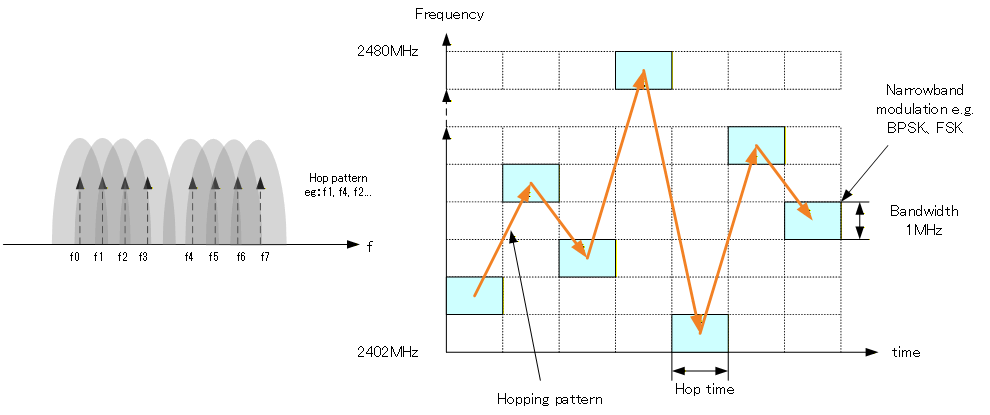
Hopping pattern
Transmitter and receiver synchronisation
For communication to occur, our receiver also has to change its frequency to match the transmitter frequency. Once synchronisation is established, it needs to be maintained for continuous communication with ways to automatically re-establish it if is momentarily lost.
Interference
Any frequency collision between transmitters can result in loss of data. With frequency hopping, the collision is only brief allowing the system to recover any lost data using secondary methods such as error correction etc. Hopping sequences are randomised as much as possible to minimise collisions among transmitters with advanced systems being able to adapt their hopping sequence to the surrounding frequencies in the area.
You might think that using the same hopping sequence with all transmitters (as shown in the second diagram) would also work. The synchronisation keeps the patterns apart so there is no overlap, without it both patterns can completely overlap and cancel each other out.
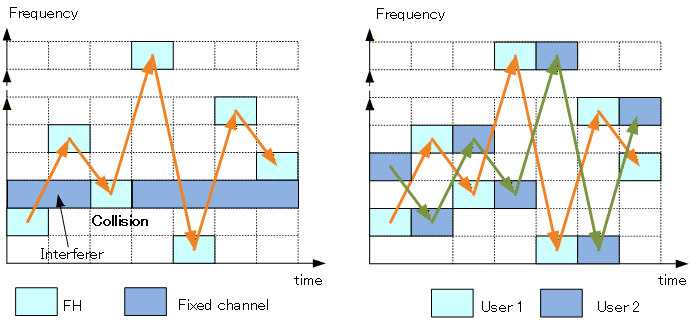
Frequency collision in Frequency Hopping. Frequency hopping with synchronisation between transmitters
FHSS advantages
- With the hopping operation automatically executed by the transmitter and receiver, it is not necessary for the user to search and manage any channels. This simplifies user operation with no breaks in communication because of a channel change.
- Because interference only happens on the possibility that two transmitters momentarily use the same frequency, overall the amount of interference between various transmitters is reduced.
- Because of the variability with frequency and wavelength, multipath effects are averaged out by hopping across the whole band rather than relying on one frequency.
- Interception of the signal is impossible unless one knows the exact hopping sequence used in the transmitter and receiver.
Direct sequence spread spectrum
In direct sequence spread spectrum (DSSS), our signal is multiplied with a PN code whose signalling rate is much higher than the message bit rate.
Spreading
We can look at an example below where our message undergoes ordinary narrowband modulation. For visualisation purposes, let us use PSK (since a "-1" or "1" simply flips the carrier by 180). In the transmitter, we multiply the message with a PN code whose signaling rate (chip rate) is much higher than the message.
Note the following PN is a length of 7 chips for every message bit, other values are 15, 31 or 63. There are now more transitions and the signal is said to be spreaded by the transmitter.
The spreading action means our signal "spreads" over a larger bandwidth than before. As the energy is now spread over a larger range of frequencies, there is a corresponding decrease in the energy per unit frequency. This makes the transmission less visible and more hidden.
The amount of spread (or deviation in the context of spread spectrum) is determined by the number of chips. The merits of spread spectrum do not become apparent unless the spreading is wide, which means opening up your band to rather large bandwidths. If the spreading was only incremental, the transmitted signal would just be another less efficient form of narrowband with zero benefits.
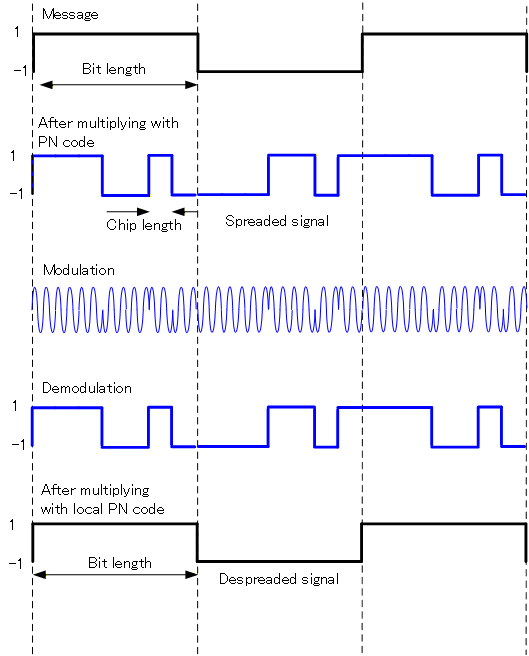
Spreading using PN code (+1, +1, +1, -1, -1, +1, -1)
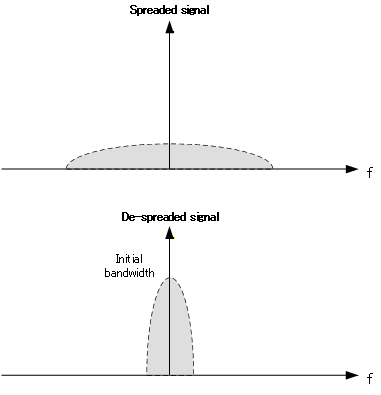
De-spreading the received signal
Despreading
Upon reception of the spreaded signal by the receiver, it is multiplied by a locally generated PN sequence that is identical and synchronised to the transmitter. The de-spreading process restores the initial bandwidth and signal level allowing the receiver to demodulate and recover the original message.
The ratio of the spreaded bandwidth to the un spreaded bandwidth is referred to as the processing gain.
DSSS advantages
- Since the spreaded signal resembles the surrounding noise, the signal is less visible to other users.
- The energy in a spreaded signal is much more distributed across frequency, so most of the signal is ignored and filtered out in a normal receiver, lessening its impact.
- Greater sensitivity by being able to bring the signal out of the noise (processing gain). This happens only if the same spreading code is used by the receiver, therefore multiple access (CDMA) is possible as users can be separated using unique spreading codes - as long as there is orthogonality between the codes.
- Because the DSSS signal can only be deciphered using the identical spreading code, this prevents eavesdropping.
- A DSSS receiver is resistant to interference due to redundancy in the extra chips - a single chip corrupted by noise can leave enough remaining chips intact so the receiver can determine the correct message bit statistically.
So which should you choose?
FHSS avoids or minimises frequency collisions by the hopping action. Even if there is a collision, FHSS hops onto another frequency. This allows multiple equipment to coexist independently with little impact on each another. In DSSS, transmitters still operate on channels, so it is still possible for a strong DSSS signal to drown out a weaker one at the same channel.
When it comes to data rate, both DSSS and FHSS have limitations compared to pure FSK. Despite the chip rate (over the air) being very large in DSSS, the throughput value is much lower compared to FHSS. For FHSS, the transition time for each hop subtracts from the data rate.
Range is a bit difficult to determine as its all down to the signal to noise ratio at the receiver. For example FHSS, each hop can still pack more energy in a smaller bandwidth meaning it has better penetration through obstacles. Unfortunately for FHSS, reception is still ultimately dependent on the available signal to noise ratio at the receiver. DSSS, on the other hand has processing gain and a signal can be brought out of the noise during the de-spreading process. A DSSS receiver can have greater sensitivity over longer distances.
For jamming, DSSS has the greater advantage against burst interference due to the redundancy in the extra chips. The DSSS receiver can statistically determine the correct bit even if some bits are corrupted by noise. Additionally the ability to use different spreading codes (CDMA) means a DSSS transmission cannot easily be received since the spreading code must be known. On the other hand in FHSS, a burst interference can mean a complete loss of data during a single frequency hop.
For impact on other equipment, the energy in a DSSS signal is spread out meaning the power per unit frequency is lower. Normal receivers see this similar to background noise and filter this out so the impact is minimal.
For implementation, FHSS does not require the user to keep selecting channels since it is automatically done by the transmitter and the hardware is simpler. DSSS requires more sophisticated hardware and precise alignment to perform the spread/de-spread process.
Conclusion
Spread spectrum is able to solve a lot of the limitations in fixed channel communications.
Because both FHSS and DSSS require the extra bandwidth to transmit its signals, they tend to be found in the upper frequency bands such as 2.4 GHz. If many wireless devices have to share the same band, spread spectrum technology helps to keep interference to a minimum.
It might seem wasteful to intentionally use excess bandwidth, but it is good for wide system use rather than individual use since many users can share the same frequency band.
